Is AI worth it for a small business in Portugal?

If you run a restaurant, a clinic or a shop in Portugal, you have probably been told you "need to use AI", without anyone telling you exactly what for or whether it pays for itself. The right question is not whether artificial intelligence is the future. It is whether, in your business, it earns back what it costs.
The short answer: for most small and mid-sized businesses in Portugal it is worth it, as long as you start by automating one concrete task that currently eats your time or loses you customers, rather than buying "AI" the way you'd buy a gadget. In this article I show where AI actually returns something in a small company, with examples by sector, a realistic idea of what you save, and how to test all of it at low risk.
A note on transparency. The examples below are representative of the reality of small businesses in Portugal, not audited case studies of Ankor clients. We don't use a real company name, a real client number or a testimonial attributed to a person as if it were verified. The time and cost gains are market estimates meant to give a sense of scale, not measurements of ours. We'd rather be honest about that than invent a "success story".
Is AI worth it for a small company, or only for big ones?
It is worth it for a small company, often more than for a big one, because a small business feels every lost hour and every customer who wasn't served. The affordable AI available today solves exactly those repetitive tasks.
For years, serious automation belonged to companies with an IT department and the budget to pay for it. That has changed. The AI tools that reply to messages, book appointments or handle frequent questions have become cheap and quick to set up. In a large company, a manual task disappears among a thousand people. In a small business, it's the owner or the only receptionist losing the morning replying on WhatsApp, and that's where the maths adds up fast. You don't need "digital transformation". You need to take a dull task off the back of the person who should be selling or looking after customers.
Which type of business gains the most from AI automation?
The businesses that gain most are the ones with a lot of repetitive contact: hospitality, health and local retail. Where the same questions come in every day, along with bookings and after-hours messages, there is time and money to recover through automation.
Three illustrative examples, one per sector, to make it concrete.
A restaurant in Lisbon. Reservations and takeaway orders come in by phone and WhatsApp exactly when the team is serving tables. Half the messages go unanswered or get a late reply, and the booking goes to the restaurant next door. An AI assistant connected to WhatsApp replies instantly, takes the reservation, confirms the time and only passes to a person what's genuinely out of the ordinary. The gain isn't "technology", it's no longer losing tables because nobody answered in time.

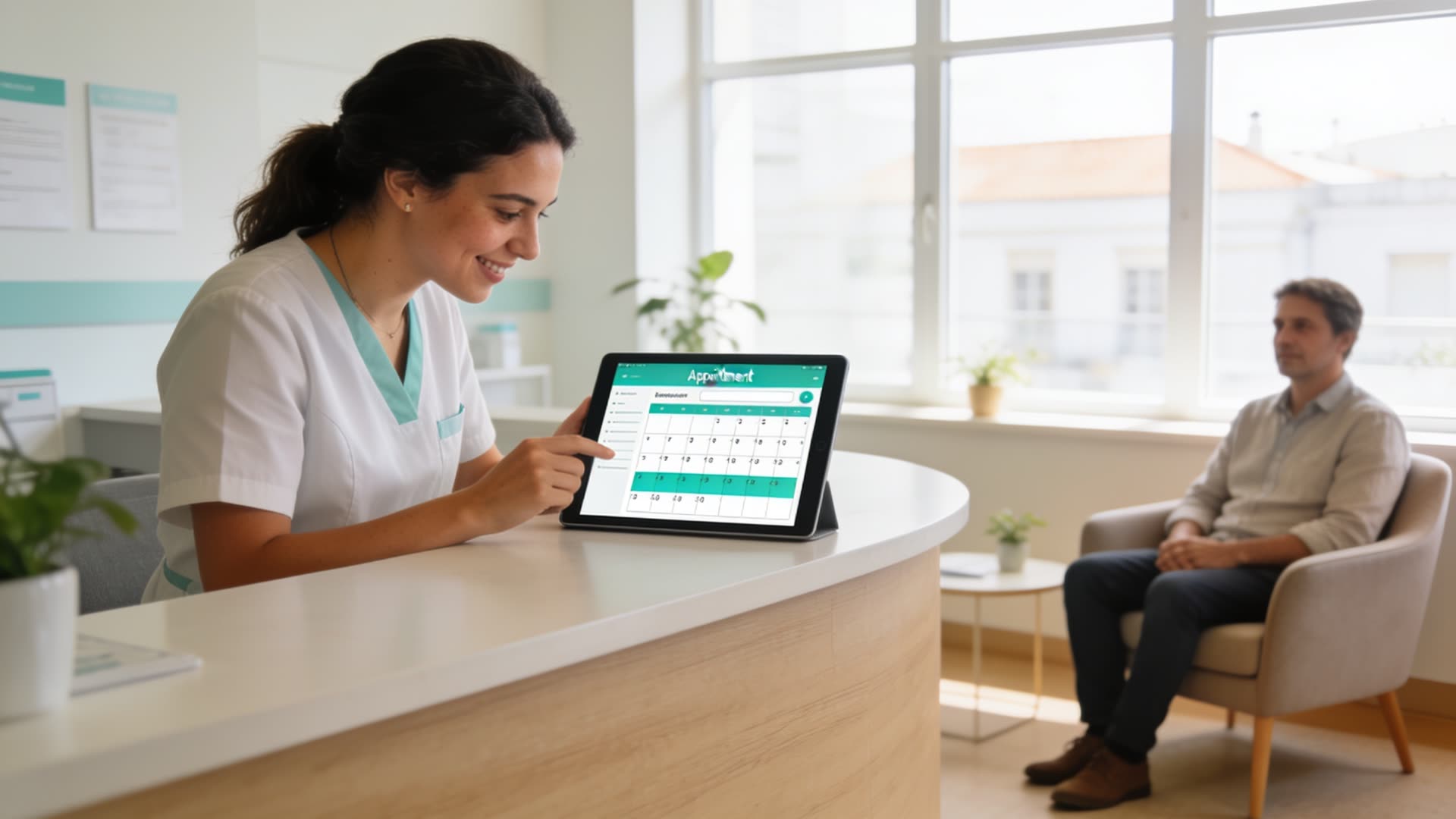
A clinic in Porto. The phone rings all day to book, reschedule and confirm appointments, and even so there are last-minute no-shows that leave gaps in the diary. An AI scheduling system books, sends automatic reminders and confirms by message, which cuts no-shows and frees the front desk to look after the person right in front of them.
A shop selling online. The same questions never stop: "do you have this size?", "what's the delivery time?", "can I still return it?". After hours nobody answers and the purchase cools off. An assistant trained on the shop's information answers these questions at any hour and hands over to a person when a decision is needed. The sale no longer depends on someone being awake at the chat desk.
Notice the pattern: in all of them, AI doesn't "replace the business". It takes a repetitive task out of the way so people can do what only they do well.
How much time and money can a small business save by automating with AI?
It depends on the task, but when you automate customer service or bookings it's realistic to save several hours of work a week and cut response time from hours to seconds. That translates into fewer lost customers.
It helps to look at this from two sides, without promising numbers we don't have. On the time side, a task like replying to messages or confirming bookings that today occupies one person in scattered chunks through the day can start running on its own, which frees that person for what earns more. On the money side, the return comes less from "cutting costs" and more from no longer losing revenue: the reservation answered in time, the appointment that didn't go unbooked, the sale that didn't cool off after hours. That's why we insist that investing in AI is about earning more, not just saving.
Which processes should a small business automate first?
Start with what repeats most and loses you customers: handling messages, booking and confirming appointments, and answering frequent questions. These are high-volume, low-decision tasks, ideal to automate.
The temptation is to automate everything at once. That's not the way. The first process to hand to AI is the one that combines two things: it happens often and needs no human judgment. Answering "what are your opening hours?" for the thousandth time is that. Deciding a delicate customer case is not. Pick a task like that, set it up well, measure the result, and only then move to the next. That way you see the return early and avoid the classic mistake of buying a giant system nobody uses.
Does AI replace employees or free up the team?
In a small business, AI usually doesn't replace people, it frees them. It handles the repetitive part so your team, which is already small, spends its time on service, on sales and on what the machine can't do.
This is the most common fear and, in a small business, the most misplaced. In a small company there is rarely anyone "spare" doing repetitive tasks. There are too few people doing everything at once. When AI handles routine messages and bookings, nobody ends up unemployed; that person gains time to serve the customer coming through the door better and to close the sale that was slipping away.
How do you test AI's ROI at low risk, without a big investment or a long contract?
Test with the smallest possible commitment: automate one task, measure it for a month or two, and decide with data. A monthly, contract-free model lets you experiment without betting a large amount upfront.

The worst way to find out whether AI pays off in your business is to pay for a big, closed project just to get the answer at the end. The smart way is to isolate one task, get it working, and look at the real numbers in your business after a few weeks. That's exactly what we built the Ankor subscription for: we implement the automation, the website and the SEO for a fixed monthly fee, with no lock-in, so you can test the ROI at low risk and walk away if it doesn't make sense. The plans are Launch at €229, Growth at €419 and Digital Team at €1,290, all monthly and contract-free, on the Ankor plans page.
Frequently asked questions
Is investing in AI really worth it for a small business?
In most cases, yes, as long as you start by automating one concrete task that currently costs you time or customers. In a small business the return shows up fast because every hour and every customer counts.
Which businesses in Portugal gain the most from AI?
The ones with a lot of repetitive contact: hospitality, clinics and health, local retail and any service that runs on bookings. Where the same questions come in every day and messages arrive after hours, there is time and revenue to recover.
How much does it cost to start using AI in a small business?
It depends on what you automate, but it is no longer a thousands-of-euros project upfront. At Ankor it starts from €229 a month, contract-free, so you can test before you commit.
Will AI replace my employees?
In a small business, usually not. It handles the repetitive part and frees your team for service and sales. There are rarely too many people in a small company; there are too many tasks for too few people.
Which task should I start with?
The one that repeats most and needs no human judgment: replying to messages, booking and confirming appointments, handling frequent questions. Automate one, measure the result, then move on to the next.
How do I know if it is paying off?
Measure before and after: response time, hours spent on the task, bookings or sales that came in. A monthly, contract-free model lets you judge with real data and stop if it does not pay off.
Want to test AI in your business without betting a large amount upfront?
Meet Ankor: automation, website and SEO for a fixed monthly fee, contract-free, so you can test the ROI at low risk. From €229/month.